—
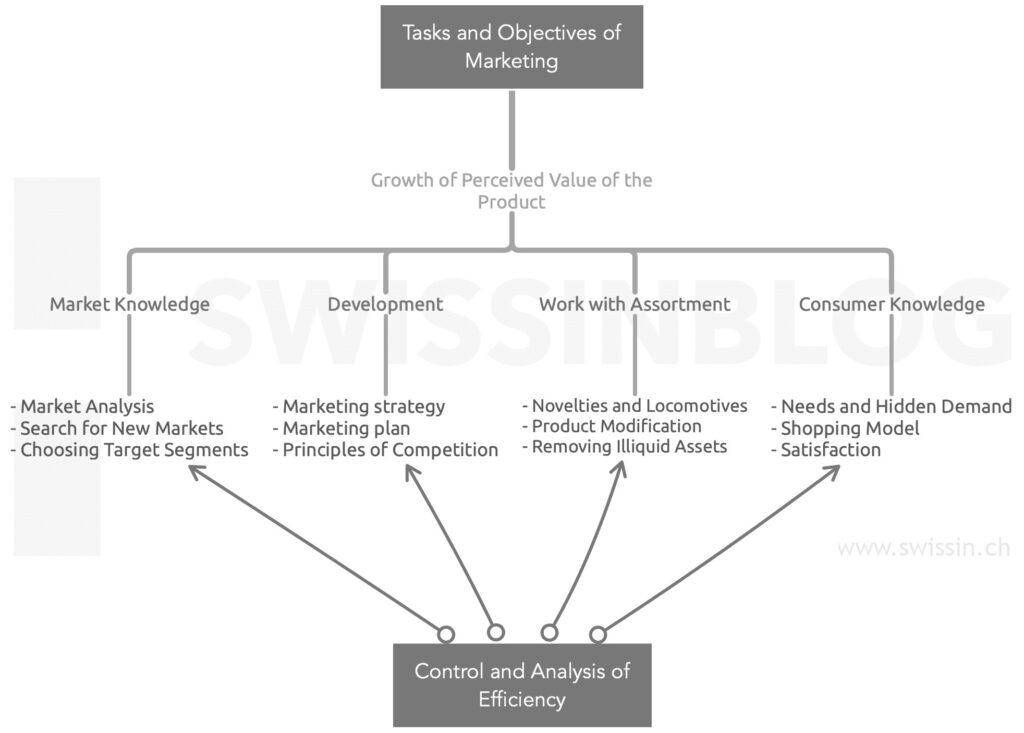
There are 6 main functions and tasks of a company’s marketing department. Knowing these fundamentals means little without applying them correctly in practice. Therefore, we will not only analyse each function of the marketing department, but also define, for each task, the main marketing goal against which the performance of the whole department can be tested.
Marketing Aim # 1: Increasing the perceived value of a product:The main task and goal of all marketing activities is to convince the buyer to pay more for the company’s goods. The value of the goods for the end buyer is determined by assessing the “perceived value of the product”, which is based on the properties and benefits of the goods. A high perceived value results from effective branding and the right advertising campaign.This marketing function can be expressed as a specific goal through unit profitability (or return on sales), growth in total sales and profit growth. Since the marketer manages the advertising budget in order to increase the product’s perceived value, the profit target is usually set net of advertising costs.
Marketing Challenges: Increasing the perceived value of a product | Market Analysis and Choosing Target Markets | Working with Customers | Developing Strategy and Principles of Competition | Company Assortment Management | Performance Analysis.
Marketing Aim # 2: Market Analysis and Choosing Target Markets:The analytical function of marketing involves continuous monitoring of the market, tracking key market trends and finding new, unoccupied niches and markets. The marketing department’s objectives in this area should focus on the regular collection of primary information on market dynamics, competitors and key market drivers. The better the company understands the market, the faster it can enter new niches, respond promptly to competitors’ aggressive moves and close down business in stagnant segments.To track effectiveness in this area, the marketing department should be set goals (sales growth) that outpace the growth rates of the key markets in which the company operates.
Marketing Aim # 3: Working with Customers:Working with consumers is a priority for any marketing department. The marketer must speak the same language as consumers and understand their needs, values, purchase decision model, reasons for refusing to buy and perception of the key brands in the industry. With this information, it is easy to segment the market, determine the company’s target audience, develop an effective advertising message and show it in the right communication channels. “Working with consumers” includes working with the current consumer base to increase the frequency and volume of purchases (which is reflected in loyalty to the company).By setting goals for growing the customer base and increasing loyalty to the company, you can always track the quality of your marketing department’s work in this area.
Marketing Aim # 4: Developing Strategy and Principles of Competition:With knowledge of the market, competitors and consumption patterns, the marketing department can develop an optimal strategy for sales growth, increase the product’s competitiveness, identify key sales markets and propose an effective strategy for promoting the company’s products. As a result, a plan of tactical measures for the year is created on the basis of the approved strategy.
Marketing Aim# 5: Company Assortment Management:Managing the breadth of the range, setting prices for goods and monitoring profitability are the main tasks of the production function of marketing in a company. The marketing department regularly monitors demand for each product, works on introducing new products to the market, identifies the company’s “locomotive” products and proposes removing slow-moving products. Effective assortment management allows you to significantly reduce the company’s storage costs, increases the profitability of sales and ensures steady sales growth for each product group in the organisation’s portfolio.
Marketing Challenge # 6: Performance Analysis:Organisational, managerial and control functions are essential tasks of any marketing activity. The marketing department constantly oversees many projects for developing new products, promoting goods and exploring new markets; it evaluates the effectiveness of the marketing programmes carried out, monitors brand health indicators and analyses its own work on an annual basis.
IMPORTANT:
As we already know, modern literature contains many definitions of the term “marketing”, but it is less important to know all the definitions than to understand that they all reflect the single essence of marketing activity: to make a profit, a company must sell its products or services to the end customer effectively and competitively.
0 Comments